You can place or change feedback until 31 December 2026, 17:00
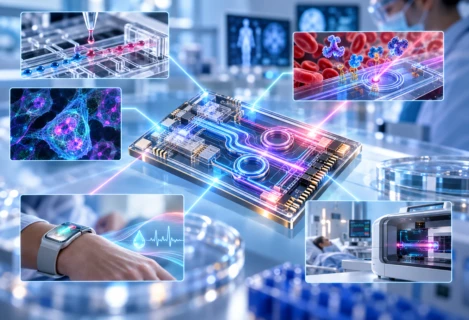
Defining the biomedical application space for integrated photonics is challenging given both the diversity of the area, and early stage at which photonic devices are being applied to the broader market. For the purpose of this document, we will define “biomedical” in the context of three areas (Figure 1). First, we will discuss chemical, biological, and imaging sensors used directly on a patient, on materials sampled from a patient, or to monitor the environment of a patient or a population. This area is one of the most discussed in the context of biomedical applications of photonic integrated circuits (PICs), but while an exceptionally active area of research it is still quite early stage in terms of market uptake. Next, the rapid progress in human health and biological understanding over the past few decades has occurred in large part due to our ability to acquire, store, and process data [i]: as such, opportunities for photonics in health-related data applications are already enormous and continuing to grow [ii]. Finally, emerging fields such as human digital twins (also known as virtual human twins) and microphysiological systems (also known as tissue chips) are allowing exploration of areas that less than a decade ago would’ve been dismissed as science fiction.
References for this section:
[i] Coughlin, S.; Roberts, D.; O’Neill, K.; Brooks, P. “Looking to tomorrow’s healthcare today: a participatory health perspective” Intern. Med. J. 2018, 48, 92-96.
[ii] Venugopal, V. “Automating care: How photonics and AI are changing medicine”, Photonics Focus (SPIE): https://spie.org/news/photonics-focus/janfeb-2024/changing-medicine-via-ai#_=_
These applications for PICs take advantage of the ability of light in a waveguide to both interact with and report on the medium in which the waveguide sits (refractive index sensing and spectroscopy), as well as applications for PICs in diagnostic imaging.
- Chemical and biological sensing for diagnostics and health monitoring: One of the earliest recognized applications for PICs outside of the data/telecom space was for biological sensing, particularly in the context of diagnostics [i]. While yet to achieve widespread market penetration, many companies are now pursuing applications of PIC biosensing either for central laboratory diagnostic systems, or at the point-of-care (POC), bringing the advantages of PICs (size, weight, and power) as well as the ability to do multiple tests simultaneously to a market that is expected to reach US$ 36.7 billion by 2026 [ii] Chemical sensors for medical diagnostics are likewise anticipated to grow in importance. Discussed in greater detail in the “Spectroscopy and Refractive Index Sensing” chapter of this roadmap, PIC sensors have several unique requirements. These include interaction with the external environment and methods for sample processing and delivery (particularly for human samples such as blood or saliva), and if the sensor is spectroscopy based, operation at a substantially broader range of wavelengths than PICs for data/telecommunications. Further discussions of packaging needs for sensors are in the Spectroscopy and refractive index sensing chapter, as well as in the Packaging chapter. Cost containment is also critical, as PIC sensors compete in the marketplace with legacy methods that can be produced at very high volume and low cost. To that end, as well as due to biosafety requirements for human samples, disposable PIC diagnostic solutions are desirable [iii],[iv]. Finally, implantable photonic devices are also of considerable interest [v], but at a very early stage.
- Theranostics: This is a concept in which diagnostics are used in combination with a particular pharmaceutical or class of pharmaceuticals in a manner tailored to a specific individual. Originally used in the context of cancer (for example, when a radiopharmaceutical agent was used to treat a patient while simultaneously being used as an imaging agent) [vi], other pairings of diagnostics and drugs are allowing expansion of personalized medicine.
- Chemical and biological sensors for environmental monitoring: As environmental conditions significantly impact an individual’s health, environmental monitoring for toxic gases and water contamination are obvious areas for application of PIC capabilities. Sensors used in the context of agriculture (see: agriculture application guide) are also important here.
- Other types of diagnostics: PICs are also beginning to be used in diagnostic tools beyond chemical and biological sensing. For example, optical coherence tomography (OCT) is a diagnostic technique that provides micron-scale three-dimensional detail of tissues. Used extensively as a method for imaging the retina [vii], it has also been applied to imaging tissues in the ear [viii], in the intestinal tract [ix], and even in neurology [x]. Several PIC-based approaches to OCT have been reported, including one based on Arrayed Waveguide Gratings fabricated at 200 mm wafer scale by Lionix [xi],[xii].
References for this section:
[i] Conteduca, D. “Photonic biosensors: Detection, analysis and medical diagnostics” Biosensors 2022, 12, 238.
[ii] https://www.marketsandmarkets.com/Market-Reports/biosensors-market-798.html#:~:text=The%20global%20biosensors%20market%20Size,7.5%25%20from%202021%20to%202026.
[iii] González-Guerrero, A. B.; Maldonado, J.; Herranz, S.; Lechuga, L. M. “Trends in photonic lab-on-chip interferometric biosensors for point-of-care diagnostics” Anal. Methods 2016, 8, 8380.
[iv] Cognetti, J. S. et al. “Disposable photonics for cost-effective clinical bioassays: application to COVID-19 antibody testing” Lab Chip 2021, 21, 2913-2921.
[v] Lee, G.-H. et al “Multifunctional materials for implantable and wearable photonic healthcare devices” Nat. Rev. Materials 2020, 5, 149-165.
[vi] Burkett, B. J.; Bartlett, D. J.; McGarrah, P. W.; Lewis, A. R.; Johnson, D. R.; Berberoflu, K.; Pandy, M. K.; Packard, A. T.; Halfdanarson, T. R.; Hruska, C. B.; Johnson, G. B.; Kendi, A. T. “A review of theranostics: Perspectives on emerging approaches and clinical advancements” Radio. Imaging Cancer 2023, 5, e220157.
[vii] Sakata, L. M.; Deleon-Ortega, J.; Sakata, V.; Girkin, C. A. “Optical coherence tomography of the retina and optic nerve – a review” Clin. Exp. Opthamol. 2009, 37, 90-99.
[viii] Ivan Tan, H. E.; Santa Maria, P. L.; Wijesinghe, P. “Optical coherence tomography of the tympanic membrane and middle ear: a review” Otolaryngol. Head Neck Surg. 2018, 159, 424-438.
[ix] Tsai, T.-H.; Leggett, C. L.; Trindade, A. J.; Sethi, A.; Swager, A.-F.; Josh, V.; Bergman, J. J.; Mashimo, H.; Nishioka, N. S.; Namati, E. “Optical coherence tomography in gastroenterology: a review and future outlook” J. Biomed. Opt. 2017, 22, 1-17.
[x] Xie, J. S.; Donaldson, L.; Margolin, E. “The use of optical coherence tomography in neurology: a review” Brain 2022, 145, 4160-4177.
[xi] Rank, E. A. et al. “Towart optical coherence tomography on a chip: in vivo three-dimensional human retinal imaging using photonic integrated circuit-based arrayed waveguide gratings” Light Sci. App. 2021, 10, 6.
[xii] https://www.lionix-international.com/photonics/applications-of-photonic-integrated-circuits/oct/
Many of us remember visiting our primary care practitioner and seeing seemingly endless sets of files full of patient data. These are now largely gone, replaced by the electronic medical record (EMR). Beyond the EMR, personal health data can be gathered, archived, and analyzed continuously from an ever-increasing range of devices. These vast sources of data create opportunities for precision, personalized health care, but also create challenges in terms of storage, processing, and safeguarding sensitive information about individuals [i]. PIC-based devices are well situated to address these needs. Two examples of relevant sub-markets are:
- Processing sensor or diagnostic data: Data from PIC biological and chemical sensors, must be aggregated, and monitored over time to reveal changes in the health of an individual. Aspects of this are already available in the form of packages that store and analyze data from continuously-worn smartphones and other devices, but we can expect both rapid expansion of capability as new body-worn sensors become available and as integration with central lab or point of care testing occurs.
- Artificial intelligence / machine learning: An early application of AI/ML in biomedicine is likely to be image analysis, enabling rapid assessment of results from X-ray, magnetic resonance imaging (MRI), PET scanning, and other emerging methods [ii],[iii]. These systems have large needs for data I/O (image transfer), storage, and computational power to run the AI models. PICs have been shown to be well suited for AI applications [iv].
References for this section:
[i] Thapa, C.; Camtepe, S. “Precision health data: requirements, challenges and existing techniques for data security and privacy” Comput. Biol. Med. 2021, 129, 104130.
[ii] MacEachern, S. J.; Forkert, N. D. “Machine learning for precision medicine” Genome2021, 64, 416-425.
[iii] Chan, H.-P.; Samala, R. K.; Hadjiiski, L. M.; Zhou, C. “Deep learning in medical image analysis” Adv. Exp. Med. Biol. 2020, 1213, 3-21.
[iv] Skuse, B. “The virtuous circle of AI and photonics” SPIE, 2024 (https://spie.org/news/photonics-focus/janfeb-2024/exploring-the-ai-photonics-virtuous-circle#_=_ ).
- Digital twins: The use of digital twins – computational models of a device which are used to assess its functional state and predict failure – has become widespread in manufacturing [i]. Digital twinning of humans (also known as “virtual human twins” or VHTs in an EU funding initiative [ii]) is currently being used to model aspects of the human body such as the immune system [iii] and in the long run is anticipated to enable accurate modeling of individuals [iv]. When used in combination with “real” patient data such as that coming from PIC diagnostics and biosensors, VHTs should allow even more precise targeting of therapies to an individual.
- Microphysiological systems (MPS): Microphysiological systems, also known as tissue chips or “organs on a chip”, are devices in which three-dimensional cultures of multiple cell types fed by precision microfluidics are used to mimic human organs. These devices serve as tools for basic biological experimentation, and are a very attractive alternative to animal disease models for testing new candidate drugs. The U. S. Congress has recognized the importance of this area, and in passing the FDA Modernization Act 2.0 in December 2023 required the U. S. Food and Drug Administration (FDA) to accept data from MPS as an optional replacement for animal data when it considers new drug applications [v]. As such, MPS development is widely recognized as a large market opportunity, with one early company in the space (Emulate) having an estimated valuation of $500 million - $1 billion. While to date assessment of MPS experiments largely relies on post hoc fluorescence microscopy and sampling of fluid from microfluidic systems, sensor development for continuous monitoring is an acknowledged need. One example showing how this can be done with integrated photonic sensors has been published [vi]. We can anticipate that this area and its need for PIC based sensors will continue to undergo rapid expansion.
References for this section:
[i] Mihai, S., et al. “Digital twins: a survey on enabling technologies, challenges, trends and future prospects” IEEE Comm. Surv. Tutorials 2022, 24, 2255-2291.
[ii] https://digital-strategy.ec.europa.eu/en/policies/virtual-human-twins
[iii] https://www.nokia.com/thought-leadership/articles/digital-twin-of-the-human-immune-system
[iv] Boulos, M. N. K; Zhang, P. “Digital twins: from personalized medicine to precision public health” J. Pers. Med. 2021, 11, 745.
[v] Zushin, P.-J. H.; Mukherjee, S.; Wu, J. C. “FDA modernization act 2.0: transitioning beyond animal models with human cells, organoids, and AI/ML-based approaches” J. Clin. Invest. 2023, 133, e175824.
[vi] Cognetti, J. S. et al “A photonic biosensor-integrated tissue chip platform for real-time sensing of lung epithelial inflammatory markers”, Lab on a Chip, 2023, 23, 239-250.