You can place or change feedback until 31 December 2026, 17:00
1.
Introduction of the application field
Aerospace is the industry encompassing all types of aircrafts (manned or unmanned), helicopters, and all higher orbit spacecrafts, either for telecommunication purposes, earth observation or space science. In the aerospace market it is increasingly recognised that PICs are a technology offering a strong potential to improve performance of the existing aerospace system based on electronic or photonics solutions. PIC technology is likely to become an enabler of new market applications and verticals such as embedded structural health monitoring, free space optical (FSO) links, on-board connectivity or remote sensing. Aerospace applications are continually seeking stringent improvements in size, weight, and power (SWaP) along with improved reliability and lower cost. Unlike other markets such as terrestrial data-centres, aerospace applications are capable of paying a premium to attain these improvements, making the aerospace market an ideal market for early adoption of PICs for commercial applications. Aerospace covers a broad spectrum of photonic applications, in particular Telecom, Datacom and Sensing applications.
However, the development roadmap for PICs in aerospace must solve a few important challenges which are listed below:
PIC material
Not enough radiation and reliability data.
Various PIC materials available, a single ideal platform suitable for all functions does not yet exist.
PIC packaging
Impact of packaging on the PIC performance
No standard package available for Space
Electronic-photonic compact integration
Hybrid integration of different PIC platforms
Custom PIC design
Expensive and lengthy and may require several iteration cycles, which leads to high non-recurring costs.
COTS devices may not be suitable and may be overdesigned without minimising SWaP factors.
PIC operation
Not enough data available related to PIC operation under harsh aerospace conditions, e.g. impacts of radiation, vibration and temperature cycles under vacuum
Aerospace grade devices
Only a few photonic PICs have been manufactured and tested by Space industries
Commercial PIC-based modules for Space not yet available. One factor that may have slowed-down the introduction of PICs in space is the fact that the space domain does not offer mass production scales like terrestrial networks, and therefore suppliers struggle to find enough return on investment for this niche.
There are still no Space standards for PICs
This roadmap will outline the steps required to develop and implement PICs in aerospace and will highlight the potential benefits of this technology for the different businesses.
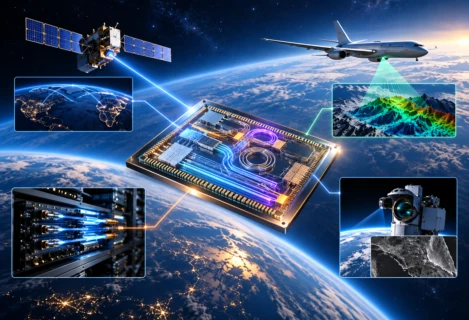
In Figure 1, we illustrate the full range of photonic applications for aerospace. Note that PICs will not be present in all of these areas, so in the next section we concentrate on those that PICs will make a difference.
Figure 1. Photonics applications in the aerospace industry.
2.
Application-specific requirements
Below we provide a short introduction to each aerospace application where it is expected that PICs will have a major impact.
2.1
Intra aircraft/satellite photonics
In regards to what is known as intra-satellite communications (and also applicable to intra-aircrafts), which mostly includes on-board signal processing, interconnecting and computing, PICs are required for the following four typical applications:
Digital photonic interconnects, e.g. for high speed serial links (HSSL) or data transfer. Silicon Photonic (SiPh) PICs are becoming the enabler for co-packaging solutions with ASIC/FPGAs targeting 100 Gbps per channel and more. The advent of PICs in this context is mostly driven by data center applications where extremely high data rates exceeding 400G on single SFP modules are required and where the electrical connections to and from the chip must be minimised and power reduced.
Analog photonic interconnects, e.g. RF over fibre (RFoF) links between antenna and processor or local oscillator (LO) signal distribution. PICs can be employed to implement more sophisticated transmitters that could integrate modulators and filtering/amplification stages, or receiver chips with integrated splitter networks at the input feeding multiple photodetectors for point-to-multipoint applications.
Photonic processing, e.g. microwave photonic beamforming, switching, filtering, frequency conversion. In general, these are functionalities that can be added to digital or analog photonic links. PICs are the essential building blocks to achieve such functionalities, especially for applications requiring a very high number of control points. Here, a compact electronic-photonic monolithic integration is mandatory.
Microwave photonic beamforming deserves special attention as it is considered an strategic technology for future very High Throughput Satellites (vHTS) where the capacity demands will require the use of phase array antennas made of thousands of elements. At the moment there are two main methods in use, but both have drawbacks:
Analogue RF processing: low power, but tends to scale poorly with the number of beams. Scope to reduce size and weight is limited by the radio wavelength being processed. Different RF bands require different designs.
Digital processing: techniques applicable to any band and can produce a large number of beams in a compact implementation. However, it tends to be quite power-hungry.
Compared to analogue RF and digital processing, microwave photonics is an alternative method that is amenable to a low power implementation (like RF analogue), but works at all RF bands and can be implemented compactly (like digital) and at low mass due to the use of optical fibres. Here, the individual RF signals that form the phased array are converted to the optical domain in which the phase shifting (and potentially amplitude control) occurs in order to form the beam. For multi-beam applications this becomes complex as the number of control points is usually NxM, being N the number of antenna elements and M the number of beams. While true-time delay (TTD) beamformers have been prototyped by Lionix for Viasat [Lionix. Accessed 22 April 2022, “LioniX International secures major satcom contract.”,retrieved from: https://www.lionix-international.com/about-us/blog/lionix-international-secures-major-satcom-contract], a compact photonic-electronic integration has not been achieved so far.
Optical computing. Photonic computing can be subdivided into binary computing, i.e. the attempt to rebuild a digital computer, and linear analog computing. The latter has been gaining attraction recently due to the massive need for vector-matrix multiplication for neural network training, which is linear computing. For such niche applications, optical computing can outperform electronic computing in terms of speed and power. Based on these applications, commercially available photonic computers are now available [M. Wolverton (1 March 2022). Accessed 22 April 2022, “Let there be smart light: Photonic computing to power AI and more”, retrieved from: https://spie.org/news/photonics-focus/marapr-2022/harnessing-light-for-photonic-computing?SSO=1] and practical examples such as vowel recognition based on photonic neural networks have been demonstrated. While the maturity level and availability is currently still limited, photonic computing may be of interest where low SWaP is required and intense linear computing is required, e.g. neural networks running on satellite missions. However, the impact on aerospace is likely to be small in the near future.
2.2
Free space optical communications
Very high-speed optical feeder links between a network of optical ground stations (OGS) and telecommunications satellites in geostationary orbit will require the use of PICs for the coherent FSO communication chain blocks.
As long-haul Optical Transport Network (OTN) have been the traditional users of coherent modulation, and because for many years now, coherent optical modules (typically hot-pluggable coherent optical transceivers that use coherent modulation (BPSK/QPSK/QAM)) have been developed and deployed by industry (Cisco, Lumentum, Nokia,…), this is naturally towards this supply chain that space actors moved for FSO coherent links implementation.
Such products historically embedded and still embed more and more complex PICs-based devices.
Initially supported by InP platforms (transmitter chips), this market now offers more and more opportunities for Si-based photonics. But in both cases, and to support the demand of bandwidth increase for terrestrial transmission applications, PICs devices shall face the integration of a higher number and diversity of functions: light emission, light detection, laser frequency tuning, optical amplitude amplification, optical amplitude attenuation, optical phase tuning, optical modulation, optical multiplexing, and optical demultiplexing. More than hundreds of functions can be now available onto a single chip.
In this context, space actors shall meet the following challenges:
Since PICs development costs are very expensive, the definition of the free space optical link shall be compatible (as much as possible) to the terrestrial supplier’s portfolios.
Those extreme data rates requiring very demanding on-board computing (DSP), whose compatibility with PICs engine is key, co-design and co-development of the technical solution with the optical modems suppliers might appear mandatory. Therefore, adoption of PICs for this space domain seems to impose a quasi-obligatory partnership for space actors with those companies; only intersatellite FSO links (i.e without strong additional on board computing required by the cross atmospheric optical links inherent to the GEO feeder links), might be potentially spared by this constraint.
Last but not least, those very complex PICs based products might appear very difficult to qualify or spatialize as they are (radiation sensitivity, reliability, packaging, non space qualified driving electronics at proximity)
The short-term objective shall be to evaluate the robustness of these COTS for space application and characterise space specific failure modes if any.
The tunable laser, together with HB-CDM (High Bandwidth Coherent Driver Modulator) and µICR (Micro Integrated COherent REceiver) are the core components for optical communication systems.
In particular, the obsolescence to the actual DFB on the market leads to an interest in the ITLA (Integrable tunable laser assembly).
These components, also available on the actual terrestrial market, are based on PICs technology (SiP). The ITLA allows the use of a tunable laser along the C band, which is an improvement for optical communications. The SWaP is also reduced with the introduction of Nano-ITLA.
In conclusion, the high development effort on telecom for terrestrial applications led to the production of components with PIC technology. Thus, in order to maintain affordable costs, the baseline of space application is to use as much as possible the available COTS.
2.3
Quantum
A lot of attention has been recently devoted to the development of Quantum PIC (QPIC) technologies with high potential impact on the quantum technology Industry, including applications in quantum sensing, communications (e.g. space borne QKD), computation and simulation. This involves the the development of QPICs capable of operating at cryogenic temperatures and with low power consumption, as well as the incorporation of specific quantum functionality into PIC platforms: single photon and entangled photon pair generation, single photon and photon number detection, and quantum memory elements.
2.4
LIDAR
The IPSR-I Automotive Product Emulator contains a significant discussion on Lidar and other integrated photonic technologies for Automotive applications. In contrasting the application needs between these two similar markets, one discovers guidance as to the short- and long-term business opportunities in each market. In the Automotive market low cost and correct detection under a vast array of visual and weather conditions is essential. In the aeronautical market there are fewer threats to detect because of existing sources of information and the cost requirements are significantly relaxed. However, false results cannot be tolerated. Thus, it is anticipated that the penetration of Lidar market initially will be greater in aeronautical markets. The penetration will be slower in the automotive applications, but the value of the Automotive Lidar market will quickly exceed the aeronautical market. The Lidar section of the Automotive Product Emulator provides a more detailed discussion of potential applications.
Some examples of LIDAR realised on PICs can be found below:
Quanergy, which was the first company to introduce OPAs in automotive LIDAR, they incorporate OPA Photonic IC in their solid state S3 product line (https://quanergy.com/products/s3/).
2.5
Optical Interferometry
Among complex optical systems, interferometers represent perhaps one of the most important classes of optical sensors and scientific instruments ever developed. Today, interferometric techniques are key to applications such as displacement measurement; for space applications, it opens the door to beam angle monitoring or mirror alignments functions, all necessary for optical instruments (embedded onto earth observation satellites families) calibration.
In these applications, the preferred mode is the heterodyne interferometer. However, modern heterodyne interferometers are complex systems requiring bulk optical devices to be implemented. As a result, they are large and expensive precision instruments limited to industrial and highly customised scientific applications. Above all, it limits their dissemination towards all classes of space equipment and optical instruments.
The development of a chip-scale integrated interferometer, with its significantly smaller form factor, increased stability, and lower cost, could greatly expand the application of interferometric techniques. Leveraging silicon photonics, the required components can be realised on-chip, allowing for a low-cost, high-precision interferometer to be implemented.
2.6
Fiber optic sensing
While fiber optic sensing (FOS) on aircrafts has been under investigation for some time already, their use in space is mainly centred in the structural Health Monitoring of Payload Fairings for the spacecraft. PIC-based sensing refers to the scenario where the light is sent into the fiber with a light source and measured back directly on the PIC [REFER to https://bits-chips.nl/artikel/photonfirst-ready-to-claim-world-leadership-in-integrated-photonic-sensing/].
2.7
Spectrometry and calibration
Current spaceborne spectrographs are limited by their spectral sensitivity and the in-orbit stability of it. Faster, space-compatible calibration sources are required to achieve higher sensitivity enabling finer scientific product delivery and/or more agile systems. On-chip microring resonators for frequency comb generation have been demonstrated to provide the required multi spectral line source to outperform current spectrographs (target TRL 4) [Rivière, R. et al, 2021, June. Space spectrograph design to calibration. In International Conference on Space Optics—ICSO 2020 (Vol. 11852, pp. 1815-1822). SPIE.] Stability, tunability, throughput and compactness are key parameters provided by this new technology, enabling in-space operation.
3.
Outlook
We have shown that Photonics Integrated Circuits (PICs) have important applicability in the aerospace field, as they have the potential to enable small, low-cost, and reliable systems with low power consumption. To finish with, in the following table we illustrate the most relevant photonic functions for the next generation of telecommunication satellites where PIC-based building blocks are key enablers.
Table 1. PIC-enabled functions for the next generation of telecommunication satellites
NEED
PAYLOAD BENEFIT
Available by year
ASIC/FPGA with co-packaged optics capable of running at 56/112G
HSSLs power can be reduced to 1/3 of current figures
2028
Multi-channel RFoF modules
Fiber optics benefits over copper for antenna to processor interconnects
2028
Optical frequency generation units
Exploiting frequency conversion in the photonics domain can halve the power required to do RF up-/down- conversion with currently employed technologies
2030
Photonic beamformers
Lowest power, frequency agnostic and highest scalable beamformers.
2030
Large optical switch
High density (hundreds to thousands of I/O), low loss and low power optical switches will be required to maximise the flexibility and power efficiency of our payloads.
2030
Fully-photonic ADC & DAC
Simplify the signal path while leveraging the photonics high bandwidth and low latency
2035
Space qualified 100 Gbits coherent modems
Mandatory for GEO feeder links and Very High Throughput Satellites: highly complex PICs based devices
2027
Spotted something that should change?
Contributors can comment per section until
31 December 2026
, when this review window closes.